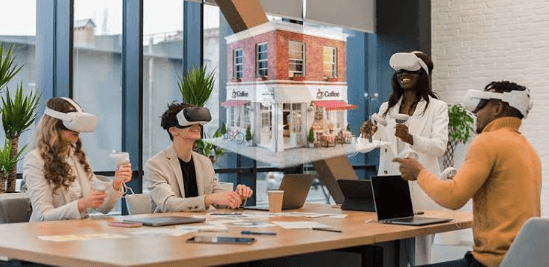
VR in employee training offers immersive, risk-free practice that accelerates onboarding and builds competence. It yields objective analytics, enabling targeted skill development and repeatable scenarios. By simulating hazardous or complex tasks, it strengthens decision-making, compliance, and performance while supporting continuous improvement through data-informed feedback. Strategic platform choices, pilot-driven rollout, and clear metrics enable scalable, cost-efficient training aligned with business goals. The question remains: how to choose use cases and measure real impact as implementation unfolds?
How VR Transforms Employee Skill Development
VR technology reshapes how employees acquire and refine skills by offering immersive, risk-free practice environments with measurable outcomes. It enables targeted skill development through repeatable scenarios and objective analytics, guiding progress and competence validation.
In onboarding, VR in onboarding accelerates familiarity with procedures while Hazardous simulations test decision-making under controlled risk, reinforcing safety, compliance, and confidence with data-driven feedback.
Choosing VR Training Use Cases That Deliver ROI
To determine which VR training use cases yield measurable ROI, organizations should map immersive scenarios to specific performance gaps and business targets established in the prior discussion of skill development.
VR ROI hinges on disciplined use case selection, prioritizing scenarios with tangible efficiency gains and safe practice.
Data-informed criteria guide implementation, aligning learning outcomes with strategic workflow improvements and cost containment.
Measuring Success: Metrics, Data, and Impact
Measuring success in VR training hinges on defining clear metrics, collecting consistent data, and translating results into actionable impact. The approach emphasizes objective KPIs, controlled sampling, and transparent reporting to guide improvements. Data governance ensures stewardship and compliance, while bias mitigation safeguards validity of conclusions. Practitioners compare pre/post performance, job transfer, and retention, using dashboards to inform scalable, evidence-based enhancements.
Getting Started: Platform, Content, and Implementation Best Practices
Choosing the right platform, curating effective content, and establishing a clear implementation plan are foundational steps for successful VR training programs. This phase emphasizes platform selection, ensuring hardware and software compatibility, and aligning budget with expected outcomes.
Content creation focuses on realistic scenarios and measurable objectives.
Implementation best practices include pilots, feedback loops, and scalable rollout to sustain performance gains.
Frequently Asked Questions
How Does VR Affect Long-Term Knowledge Retention Beyond Training Sessions?
VR shows modest gains in long-term retention, though retention decay occurs without refresher sessions; practitioners should implement spaced repetition, integrating periodic micro-reinforcement to sustain knowledge beyond training sessions.
What Are the Privacy and Security Considerations for VR Training Data?
Initial: VR training raises privacy controls, data minimization, security auditing, and access controls to protect sensitive metrics. Practically, data governance should document purposes, limit collection, audit activity, enforce least privilege, and enable user choice for freedom-minded organizations.
Can VR Training Replace Live Onboarding and Safety Certifications?
VR adoption cannot fully replace live onboarding and safety certifications; it supplements but does not substitute real-world nuances. Practically, it supports staged onboarding replacement strategies, data-driven assessments, and scalable training while preserving essential hands-on, compliant experiences for freedom-minded organizations.
How Accessible Is VR for Employees With Disabilities or Limited Tech Experience?
VR accessibility varies; systems show accessible interfaces, intuitive tutorials, and disability friendly design, yet require hardware setup simplicity and ongoing accessibility testing to ensure inclusive use for employees with disabilities or limited tech experience.
See also: gomosimregistration
What Are Cost-Saving Strategies for Scaling VR Programs Organization-Wide?
To scale VR programs organization-wide, implement scalable hardware, standardize configurations, leverage vendor partnerships for bulk pricing, and centralize content. Track ROI with pilots, consolidate devices, and negotiate service terms to maximize utilization and minimize downtime.
Conclusion
VR-enabled training accelerates onboarding, sharpens decision-making, and delivers measurable safety and compliance gains. Anecdotally, a manufacturing firm reduced defect rates by 30% after a 6-week VR program that simulated high-risk scenarios, highlighting the power of repeatable, data-driven practice. The practical takeaway: align use cases with business goals, deploy pilot programs, and track metrics—time-to-proficiency, retention, and cost-per-learner. With scalable platforms and content, organizations achieve consistent performance improvements while containing training costs.